
In recent years, the pace of change for contractors has accelerated at a rate requiring leaders to be agile and more involved in the business than ever.
What does that mean for the modern CFO?
Long gone are the days of the CFO in a green visor, hunched over a 10-key. Today’s construction CFO is responsible for far more than closing the books, with a growing role in technology, insurance, surety, workforce planning, and operations.
Even so, finance teams are still spending a significant amount of time managing, reviewing, and closing the books on each job, with the output being a lagging indicator that might provide a lesson learned.
Construction CFOs are spending so much time looking in the rearview that it pulls them away from what their role is meant to be: A strategic, organizational driver of job profitability, past, present, and future.
That goes well beyond answering, “How did we do this month?” They should be answering questions that drive consistent growth in margin:
- What is my cash flow forecast showing?
- Which work should we pursue next?
- Can our fleet and labor force support that work profitably?
- Can our surety bonding cover the risk?
- What does this mean for insurance liability exposure?
- How can we improve processes and eliminate unnecessary burden?
- What are other contractors doing to protect and grow their margins?
- Where is the industry going (i.e., what emerging sectors are driving demand)?
When operational and financial data is captured with enough fidelity and accuracy, experienced financial experts can project future revenue and cost to confirm liquidity and address backlog risk for upcoming projects.
From the Rearview Mirror to the Windshield
A little while back, I had a conversation with Neil Shah, President and CEO of the Construction Financial Management Association (CFMA), and Will Hipp, Senior Product Marketing Manager at Tenna.
Shah describes the CFO’s shifting role as learning to “look through the windshield as opposed to the rearview mirror.”
Shah added, “The books are really about looking backwards. But increasingly, our members, the ones that are driving their firms, are looking at risk management and mitigation practices. They’re looking at talent development and talent acquisition. They’re looking at investments in equipment… Investments in other firms… One of the things we’ve been trying to drive is, not only the notion of a windshield, but using data to make decisions.”
So, when it comes to turning an 8% margin into, say, 11%, it comes down to data, and how that data gets used and adopted throughout the org.
That perspective ran throughout my discussion with Neil Shah and Will Hipp, which you can watch below.
Throughout the rest of this article, we’ll discuss the takeaways from the conversation, including how CFOs are using construction equipment data to inform capital and growth decisions, build interdepartmental trust, and drive strategic decisions that help scale the business.
Key Takeaways
- Equipment is one of a contractor’s largest costs, so its data belongs in capital, bid, and growth decisions alongside cash, backlog, and risk.
- Trust between the field and finance comes from capturing data inside the workflow in real time and giving equipment, operations, and finance the same record.
- Managing the fleet like a financial portfolio means weighing utilization and cost recovery alongside maintenance history, and testing fleet growth against working capital.
- Actual repair, ownership, and utilization records support and correct equipment managers’ instincts, and preserve their knowledge as experienced managers retire.
- Progress beats perfection: start with the hour meters, fuel records, and work orders you already have, and solve one bottleneck at a time.
- Choose equipment software that captures data across a mixed fleet, supports job costing and internal billing, and connects to your ERP without manual re-entry.
Equipment Data Should Inform Capital and Growth Decisions
Equipment is one of the biggest costs that contractors carry, so the data behind it belongs in the same conversations as cash, backlog, and risk.
“For heavy construction, equipment’s a big portion of what [contractors] spend,” Shah said. Purchase price, repairs, fuel, and depreciation all contribute to the construction equipment costs and lifecycle costs CFOs need to manage.
At CONEXPO, Shah noticed that tech and equipment booths alike were “all talking about data… how to better utilize their equipment by understanding how the equipment’s performing and being able to lock that into how the organization is performing.”
Understanding construction equipment economics requires connecting what the fleet costs to how it’s being used, what it’s producing, and how those costs affect job profitability. Equipment data helps finance make those connections.
Engine hours, idle time, location, fuel, and work orders show how field operations are performing, job by job. In a high risk, low margin business, these small changes add up. They paint a fuller picture of cost (and revenue leakage) and can end up adding a few percentage points to margin, across every job, helping drive steady capital and growth.
Using Equipment Data to Build Internal Trust
Machine data is now being captured in real time, automatically. That reduces manual entry and reporting delays, but by itself, doesn’t solve the interdepartmental trust issue.
As Shah said, “Trust comes from the partnership that CFOs build with the field.”
The key to driving these partnerships is:
- Capturing data inside the actual workflow in real time
- Giving every team access to the same data adequate to their roles and responsibilities
Capture Real-Time Data Inside the Workflow
Data that gets captured directly from machines, while the work is happening, is always going to be more accurate than data that’s reconstructed or remembered after the fact.
Hipp put it bluntly when he said, “For the longest time in construction, the [side effect of the] analog process was to get the work done and then worry about bookkeeping later. And by the time you get to bookkeeping later, you’ve lost all the fidelity of what actually happened, and you get junk in, junk out.”
Shah’s fix is to capture the data “at the point of attack.” If your software actually works within the workflows themselves, “the foreman and superintendents are going to use it,” he added.
And for the CFO, knowing that data is coming directly from the machine, tied to a specific job and specific hours, makes it much easier to trust.
Give Equipment, Operations, and Finance the Same Record
When finance, equipment, and the field all work from one source of data, you can reduce disputes that arise over whose numbers are more accurate.
A shared source of truth also helps CFOs communicate how and why the data gets used to help the overall business.
Shah said, “CFMA members are spending a lot more time teaching financial fluency to the operations person… Capturing the information, whether it’s on quantities, whether it’s on hours… Whatever that data is for that work schedule or that equipment life cycle cost, has meaning, and has meaning to the individual that’s providing it, and to the firm that’s using it.”
When everyone is looking at the same data, these conversations become much more fluid and can happen more often.
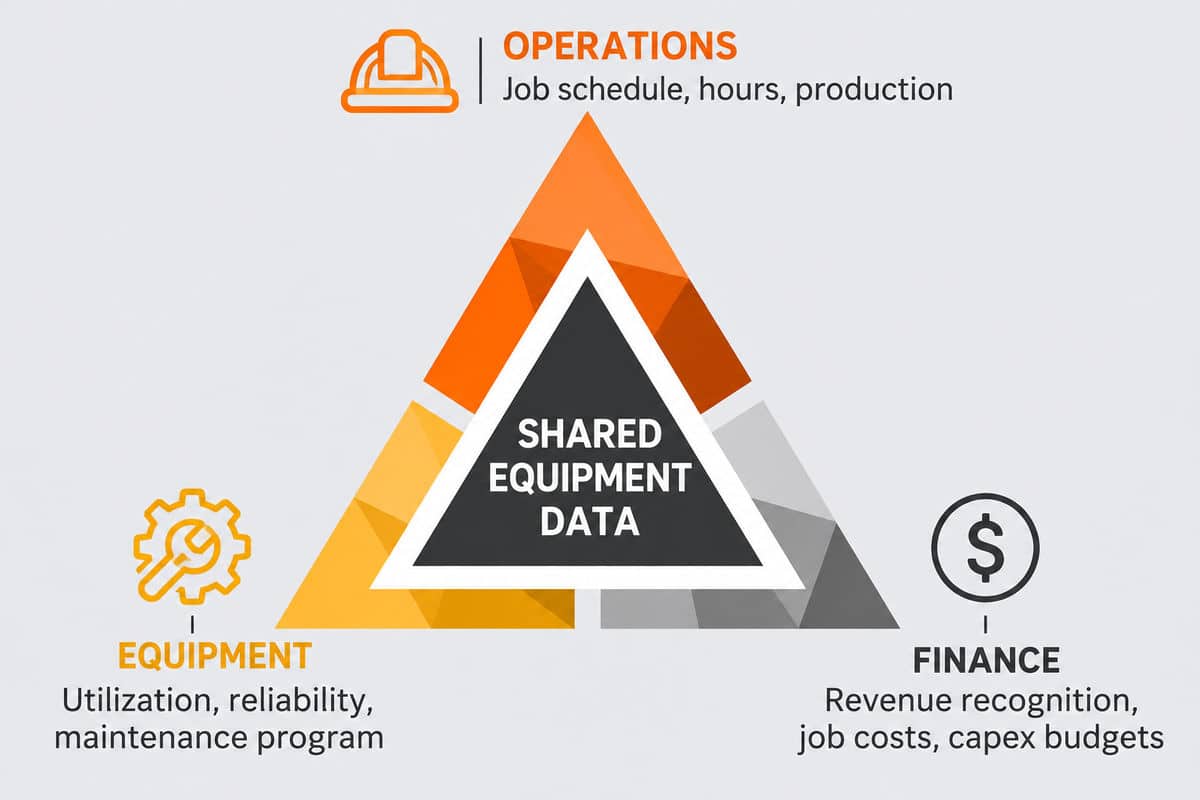
Based on the Internal Equipment Triangle concept from Craig Gramlich, Lonewolf Consulting. Equipment management, operations, and finance can each work off the same data to drive different workflows.
Equipment Data Management: Running the Fleet Like a Financial Portfolio
A lot of contractors manage their equipment like a kid with a baseball card collection. They may know the stats, but the emotional connections often outweighs the objective insights.
It shouldn’t stop there, though. Fleet management KPIs and decisions should always be informed by utilization and cost recovery, alongside that maintenance history. It’s not just how the player performs, but how their performance impacts the team.
Equipment is a massive CapEx and OpEx obligation for the company. If the fleet is managed like a financial portfolio, it can have a much greater impact on profitability and growth, as opposed to just keeping production afloat.
Manage Fleet Growth Without Losing Financial Visibility
As fleets grow, equipment managers need a consistent way to track costs, utilization, and reliability across hundreds of assets, without relying on what a few experienced employees can remember.
Will experienced this when his former company’s fleet grew from roughly 200 pieces to 450 assets after winning a major job.
“The support staff in the shop was lagging behind that scale,” he said. “They can no longer maintain all of that information in their head.”
With equipment data collected and organized consistently, leadership can identify rising costs, utilization gaps, and underperforming machines across the fleet, then prioritize where to act. Those historical records also give new leaders a foundation to build on as experienced personnel retire, preserving the knowledge needed to manage the fleet as the business grows.
Validate Equipment Decisions with Financial Evidence
Experienced equipment managers develop good instincts, but CFOs need financial evidence to evaluate their recommendations more sharply.
At 450 assets, Will said, “You need robust data to help support the gut decisions and then course correct when the gut decision may be wrong.” He added, “Data is not the enemy, it’s there to reward, but also correct.”
An equipment manager might recommend replacing an excavator that’s becoming expensive to maintain. With the right equipment data, the CFO can review its repair costs, ownership costs, and cost recovery to determine whether replacement makes financial sense or whether keeping the machine is the better investment.
With those numbers, the CFO can substantiate the recommendation or challenge it and clearly explain (and show) the financial reasoning to equipment management and other decision-makers.
Grow the Fleet Without Overcommitting Capital
A growing backlog can justify adding equipment, but the CFO needs to know whether the expected margins will support the investment and leave the company with the required working capital to adequately execute the project.
“Contractors don’t run out of work. They run out of cash,” Neil said. The CFO must weigh new equipment commitments against working capital, borrowing capacity, and the costs of delivering the company’s existing backlog.
Before approving another excavator, use equipment data from comparable projects, including actual operating hours, utilization, and ownership costs, to understand what the work has historically required. Compare those figures against the estimated margins on upcoming jobs to evaluate whether buying, renting, or reassigning equipment makes financial sense.
Use historical job margins and equipment costs to determine whether fleet expansion will improve profitability while preserving the capital needed to execute the work.
What a Construction CFO Can Do With Real-Time Equipment Data
Throughout our conversation, we discussed six decisions and how equipment data can help inform CFOs:
- Equipment investment justification. Actual usage, repair history, and ownership costs support a total cost of ownership model for heavy equipment to help justify keeping assets in the fleet, and inform repair, rebuild, replace, or rent decisions.
- Which work to chase. Track construction job profitability by project type, including equipment costs and production results, to inform future bids.
- Growth capacity. Compare the backlog with the current fleet makeup and resource schedule taking into account utilization and availability before expanding the fleet.
- CapEx Budgets. Use equipment age, reliability and utilization records to evaluate fleet condition to prepare a long term capital expenditure budget.
- Ownership transition. Fixes assets can make a business harder to afford for family or employee buyers, so owners sometimes move equipment to a separate legal entity (capital company) to lower the purchase price of the operating business. Shah noted that CFOs are increasingly helping structure these transitions, using asset costs to evaluate how to divide the business.
- Financial risk exposure. When the backlog dries up in a recession, a contractor can still be carrying hundreds of millions in CAPEX that must be sold at depressed values. Equipment cost and utilization data let CFOs weigh renting, leasing, financing, or buying each asset against the terms of each option, keeping the financial house in order.
Chasing Perfection Can Stall Progress
Don’t let perfect be the enemy of getting better. Start with what you have, address one problem, and use what you learn to tackle the next.
Neil said, “I’m going to accept something that’s 80%, because 80% is going to get me to [the next decision].” As he put it, “the concept of materiality can be an accountant’s best friend.”
Most contractors already have useful equipment data, from hour meters and OEM systems, to fuel records and work orders. Start with a specific financial question, such as: Are equipment costs making it to the right project?
Tapping into equipment data allows you to utilize the records you already have to identify areas of improvement and drive progress.
Getting reliable equipment hours might reveal inaccurate job costing practices. Fix those, and inconsistent internal equipment rates may become the next priority.
Hipp connected this approach to the theory of constraints: “Once you solve a problem, you eliminated that bottleneck. Guess what happens? The next bottleneck pops up.”
Each improvement gives you better information, exposes another opportunity, and moves the business closer to the financial visibility it needs.
Build an Equipment Management System That Works With Your ERP
I’ve heard CFOs describe having “100 systems that don’t really talk to each other.” Shah sees the ERP as the financial system of record but acknowledges that “no ERP on its own solves every workflow issue.”
Purpose-built software needs to connect those workflows without adding another layer of manual entry.
Hipp urged contractors to vet technology providers as carefully as they might for a CPA firm. For equipment management, ask:
- Data capture: Can it collect reliable equipment activity across a mixed fleet?
- Financial workflows: Does it support job assignments, configurable rates, job costing, and reviews?
- ERP connection: Can the cost data transfer without manual re-entry?
Tenna’s Asset Financials, for example, specifically automates equipment job costing and internal billing, taking data directly from machines and applying configurable rate rules to generate job cost accurately with an objective audit trail. With ERP integrations such as Vista, Spectrum, Sage, Foundation, and COINS, Tenna is built specifically for contractors.
See the Road Ahead with Equipment Data
A CFO who understands fleet cost and operating inputs can connect them to contract throughput, which gives a clearer basis for deciding what the company can profitably take on next, and where it can expand.
Tenna connects equipment activity to the financial workflows that depend on it, helping contractors account for what is ultimately one of their largest investments.