Updated July 8, 2026
Most contractors know their equipment is either working or it isn’t. What they don’t always know is how much that difference is costing them.
An excavator sitting idle for two weeks. A machine hoarded on one jobsite while another crew rents the same model down the road. Hours logged on a timecard that don’t match what the machine actually did. These aren’t edge cases — they’re the daily reality for contractors managing large, complex fleets without real visibility into how their assets are being used.
Equipment utilization software exists to close that gap. And in 2026, the best platforms do far more than track hours and location — they connect utilization data to maintenance planning, job costing, and fleet decisions so contractors can stop guessing and start managing with confidence.
This guide covers what’s changed, what to look for, and which platforms are worth your time.
What Is Construction Utilization Software?
Equipment utilization technology provides contractors with real-time visibility into exactly how, when, and where your equipment is being used. These powerful tools help you identify underutilized assets, predict and plan maintenance workflows before breakdowns occur, and make data-driven decisions about when to repair, replace, or add to your fleet.
The right equipment management solution leverages telematics data and allows you to:
Increase equipment productivity by identifying and relocating underutilized assets.
Reduce your equipment’s downtime by scheduling maintenance based on actual usage data.

Provide more accurate bid rates by giving estimators true internal costs based on accurate utilization data.
Better plan for future equipment needs as owned equipment reaches the peak of its lifecycle.
As construction professionals with over 100 years of experience, we understand the challenges contractors face in finding the best construction equipment utilization software. The market is crowded with options that vary widely in features, capabilities, and price points.
In 2026, leading platforms combine real-time telematics, historical usage data, and analytics to help contractors proactively manage fleet availability, maintenance, and cost recovery. This guide will discuss new trends in equipment utilization software for 2026 and compare the leading equipment utilization tracking solutions you’re likely to encounter during your research.
What’s New in 2026 — Key Developments Shaping Equipment Utilization Software
1. Mixed Fleet Data Centralized for Complete Visibility
Software systems now unite vehicle and equipment analytics into a single data ecosystem. This unified view helps fleet managers see utilization across both powered equipment and support vehicles — not just one category or the other — enabling better planning, scheduling, and performance benchmarking across the entire fleet.
2. One Platform System Simplifies Data Collection
Platforms are expanding direct connectivity with OEM telematics systems, pulling engine hours, fault codes, and performance data directly from the source rather than relying on manual input or third-party data transfers. These integrations reduce friction in data collection and eliminate the accuracy gaps that come from transcribed or estimated inputs, essential for utilization reporting you can actually trust.
3. Customizable Utilization Rates
In 2026, the way fleets and project teams think about utilization is evolving beyond simple hours and location tracking. Leading construction organizations are adopting configurable utilization rate systems that reflect how different asset types contribute value across projects, internal cost pools, and billing models.
Traditional utilization metrics — typically engine or run hours — don’t always equate to true value contribution, especially in diversified fleets. Yet most systems historically treat all machine hours equally. That’s no longer sufficient for contractors who need precise job costing and revenue attribution. The platforms leading this shift allow contractors to define utilization rules by asset category, project type, and operational status — so the data actually reflects how their fleet works.
4. Safety & Analytics Deepen Across Platforms
AI dash cams and Driver Scorecards are increasingly integrated alongside utilization data on a single platform. This allows managers to correlate safety events with utilization patterns, giving them a more complete picture of how assets and operators are performing together on the job.
5. Smarter Utilization to Billing & Job Costing Measurement
In 2026, utilization data is no longer just a performance metric. Modern platforms allow contractors to define custom rate sheets tied to utilization metrics — billable hours, type of use, location — so equipment costs automatically feed into internal chargeback systems and job costing workflows rather than relying on manual spreadsheets. Flexible rate structures can include hourly, daily, or project-specific rates tied directly to telematics and job log data.
The result: project managers can see utilization’s impact on the bottom line in real time, without duplicative data entry, making job profitability and forecasting more accurate. These capabilities turn utilization analytics into strategic financial inputs rather than operational afterthoughts.
1. Tenna
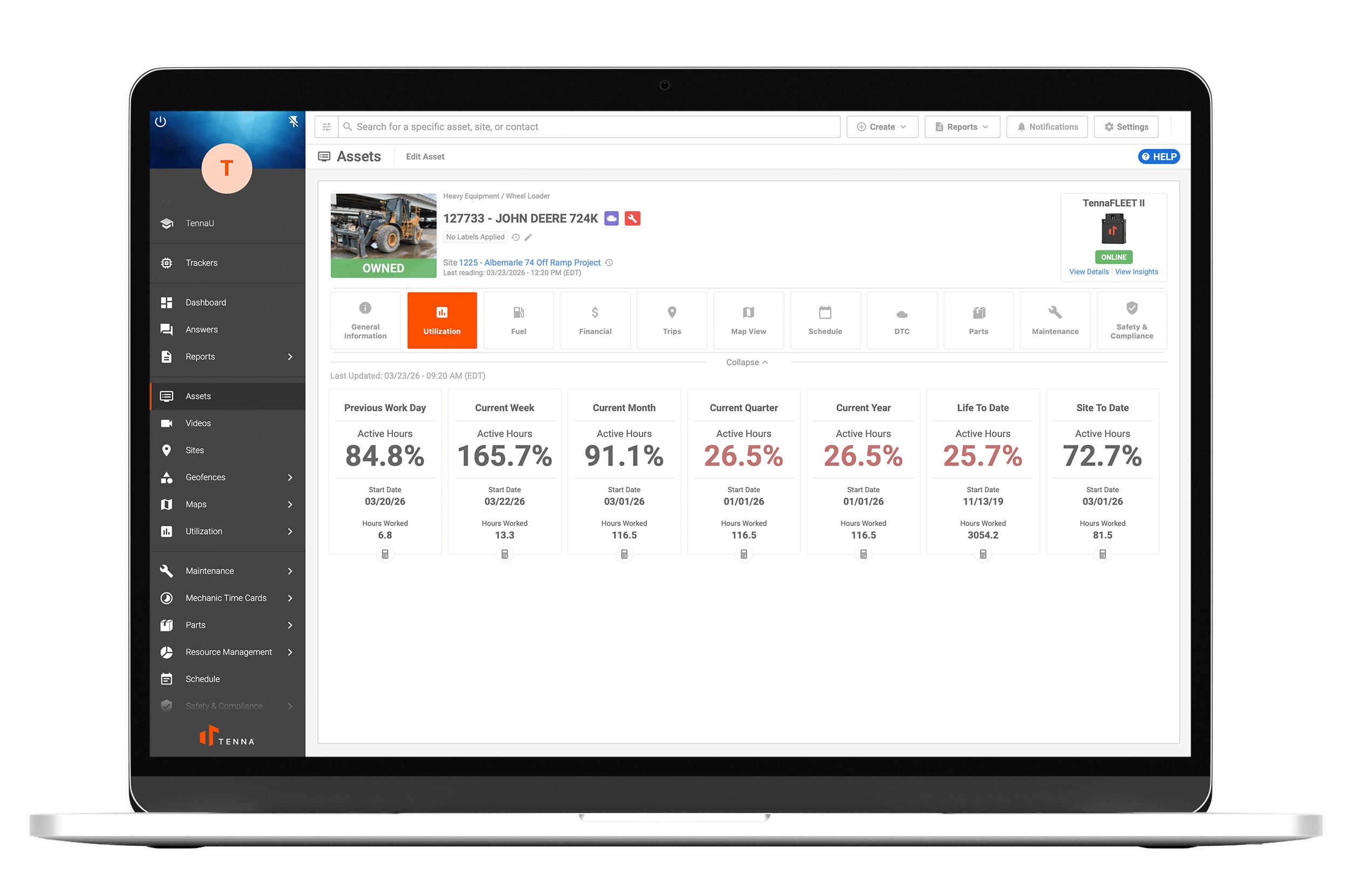
Tenna’s equipment utilization tracking software gives construction companies complete visibility into equipment usage patterns. Built specifically for contractors managing mixed asset fleets, our solution pulls telematics data directly from asset trackers hardwired to engine-operated assets to deliver accurate utilization metrics in one unified platform.
Tenna is the only construction platform that takes equipment utilization all the way to financial accountability. Tenna connects live machine data to job costing, internal billing, and equipment P&L, automatically, using the telematics data you’re already capturing.
Power Take Off (PTO)
Tenna allows you to capture when the engine is being used for an activity other than running the asset. You can view PTO status live across maps, see Trip or Cycle Events for PTO Engaged and total PTO duration, and see PTO columns in the existing Trips or Cycle Reports.
Construction-First Utilization Modeling
Tenna goes beyond basic hour tracking by supporting configurable utilization definitions and rates by asset category that reflect how contractors actually operate. Contractors can create rules for assets that move between multiple sites (e.g., water trucks or light towers), assets that mainly work at one site per day (e.g., supervisor trucks), assets where idling shouldn’t count, equipment you don’t want included in utilization analyses, and enable precise on-site work measurement where accuracy is critical.
Teams can distinguish between productive vs. idle time, billable vs. non-billable usage, and internal vs. external equipment charges. And because Tenna allows contractors to configure utilization rates based on equipment type, project, or usage scenario, that accurate data flows directly into the financial workflows that depend on it — job costing and project financials, internal equipment chargebacks, and billing and cost recovery workflows. This turns utilization from a reporting metric into a real financial control.
Asset Financials: From Utilization Data to Equipment P&L
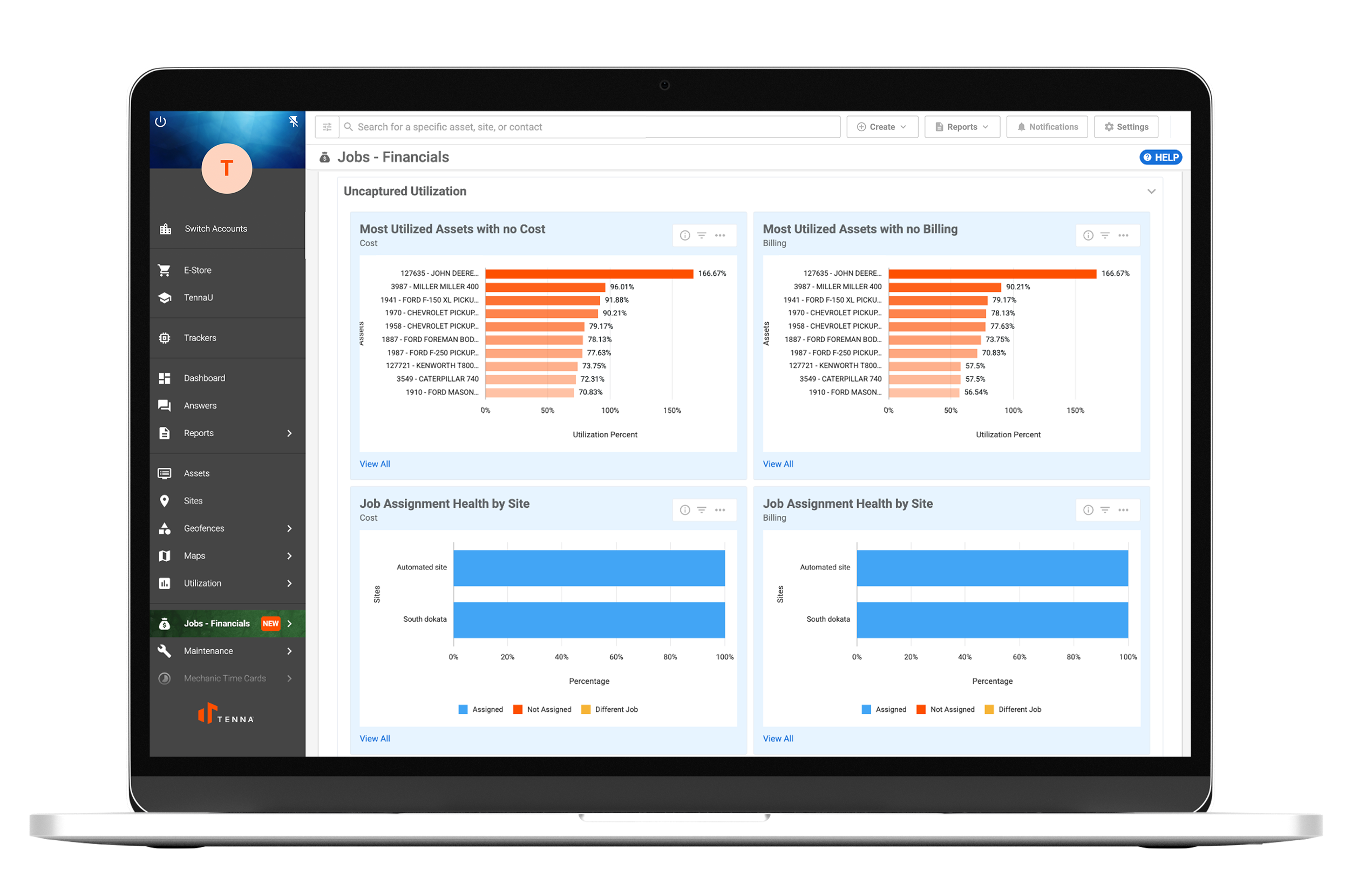
Asset Financials takes that rate logic and connects it directly to your financial workflows:
- Automatically converts utilization data into job-level cost allocations
- Applies your rate logic (by asset class, job type, utilization status) consistently across every assignment
- Rolls up work orders, parts, and mechanic labor alongside utilization costs for a complete asset P&L
- Syncs clean, structured cost data to your ERP so equipment costs flow to the right jobs automatically
Reports & Analytics
The system lets users define custom utilization benchmarks tailored to their specific fleet size and workload, making it easy to identify underutilized assets. Construction professionals can evaluate trends over time by reviewing equipment utilization reports by asset and project and measuring how often assets are working (or not working). This ultimately helps contractors make data-driven decisions about scheduling and dispatching, as well as owning, renting, or selling equipment.
For example, eliminating three to six months of rent for one Komatsu PC238 Mini Excavator at $6,500/month (plus pickup and delivery charges, taxes, service fees and final inspection dues) by mobilizing an owned, unused one being hoarded on a jobsite will save you a minimum of $20,000 for three months — and that’s just one rental asset.
Proactive Maintenance Tracking
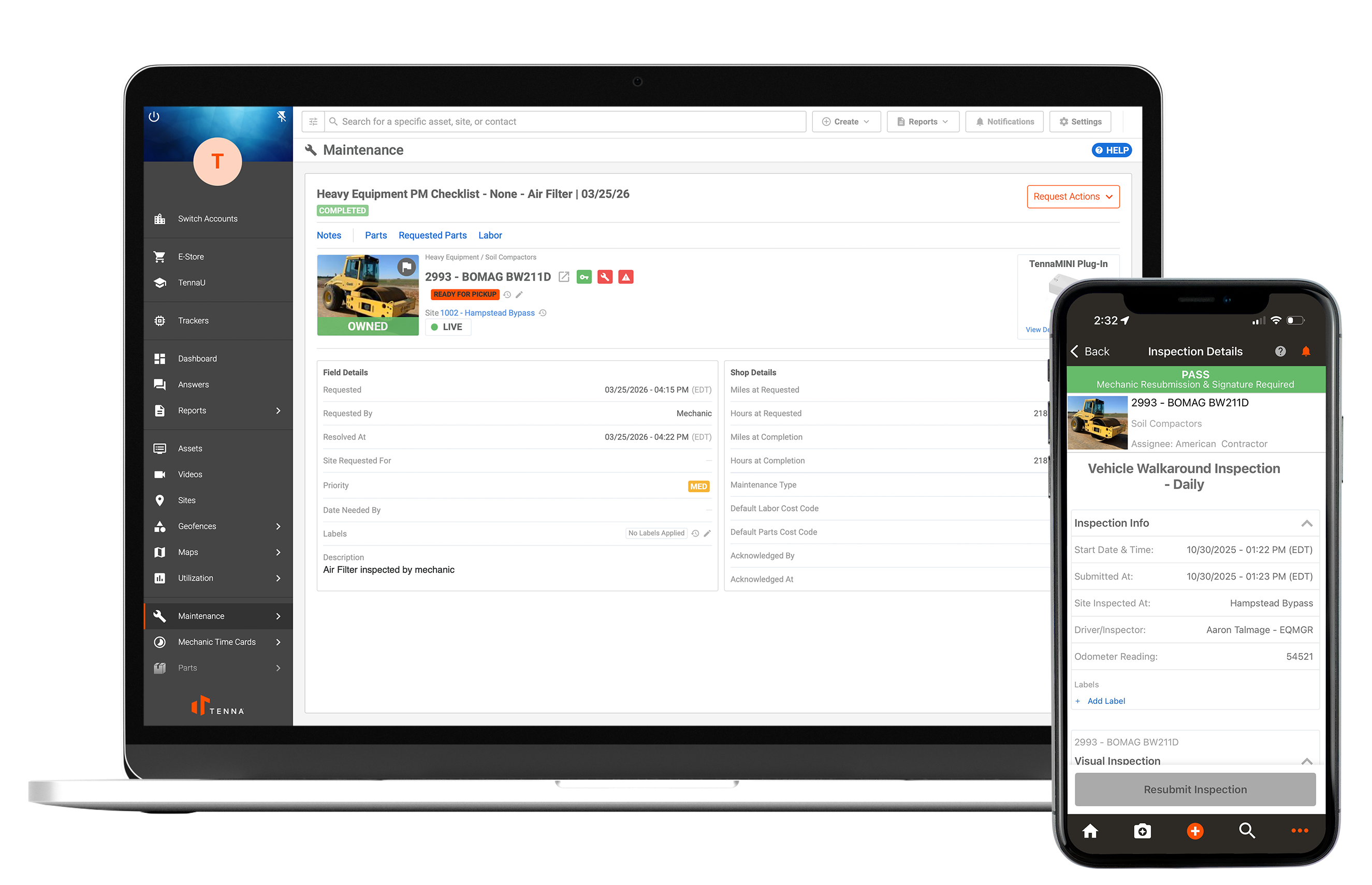
Avoid unexpected downtime with Tenna’s proactive maintenance tracking. Set asset usage triggers to get automated alerts about maintenance needs. Then monitor maintenance requests and work orders and keep track of preventive maintenance requests on one convenient dashboard.
Third-Party Tool Integrations
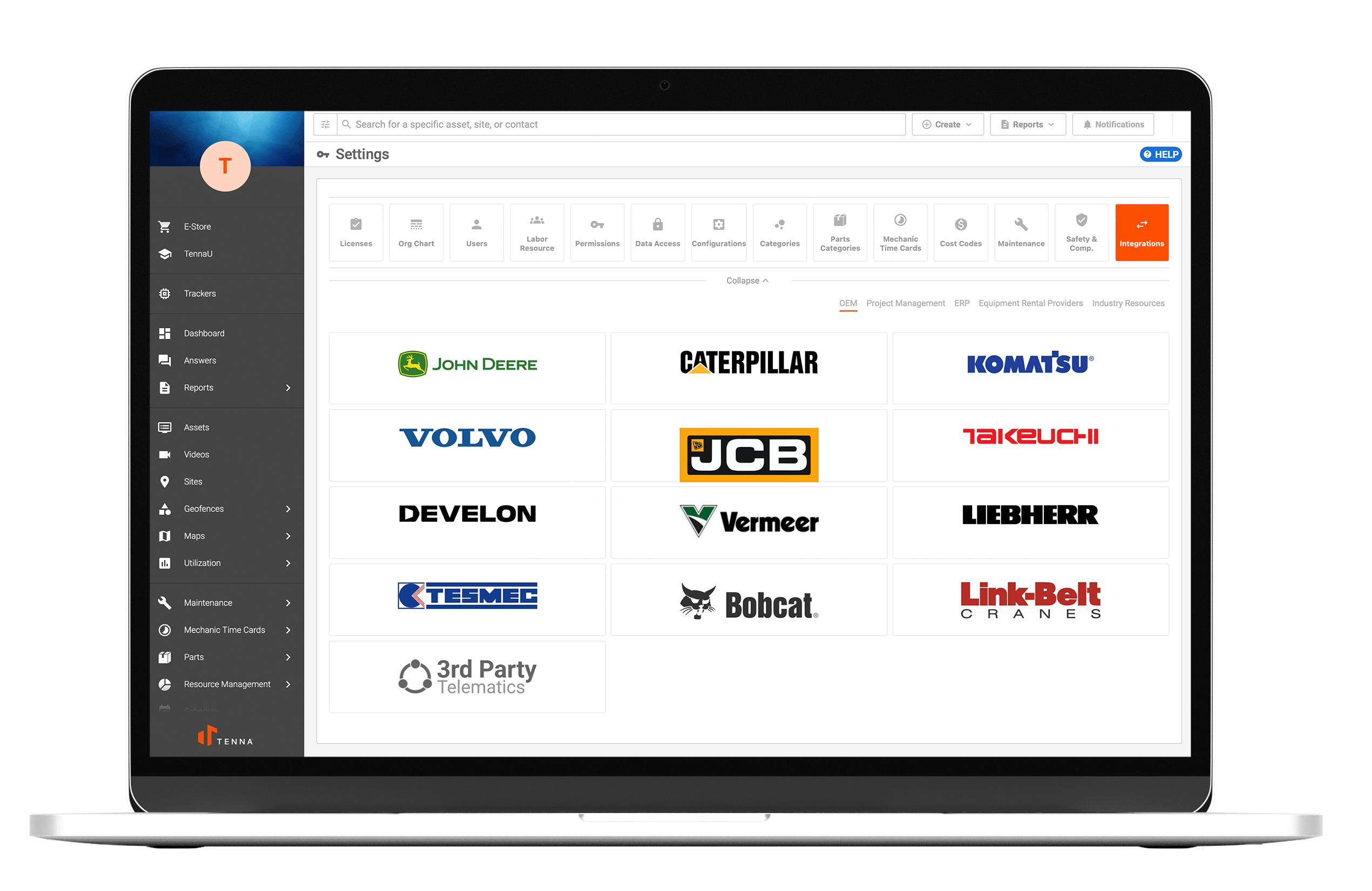
Integrate with third-party original equipment manufacturers (OEMs) to sync telematics and utilization data with Tenna.
Key Equipment Utilization Features
| Engine Run Time Monitoring | ✅ Yes |
| Real-Time Asset Tracking | ✅ Yes |
| Power Take Off Monitoring | ✅ Yes |
| Automated Maintenance Triggers | ✅ Yes |
| Fleet Management Dashboard | ✅ Yes |
| Equipment Utilization Reports | ✅ Yes |
| Configurable Utilization Rates | ✅ Yes |
| Asset-Level P&L | ✅ Yes |
| Internal Billing / Job Costing Automation | ✅ Yes |
| ERP Integration for Equipment Costs | ✅ Yes |
| Third-Party OEM | ✅ Yes |
| Third-Party Product Operations Integrations (Procore, Riskcast, etc.) | ✅ Yes |
| Mobile App | ✅ Yes |
Why Tenna Stands Apart in 2026
Most utilization platforms end at the dashboard. Tenna ends at the bottom line. For contractors who need to know not just what their equipment is doing, but what it’s costing and earning — per machine, per job, per period — no other platform connects those dots the way Tenna does.
2. Trackunit
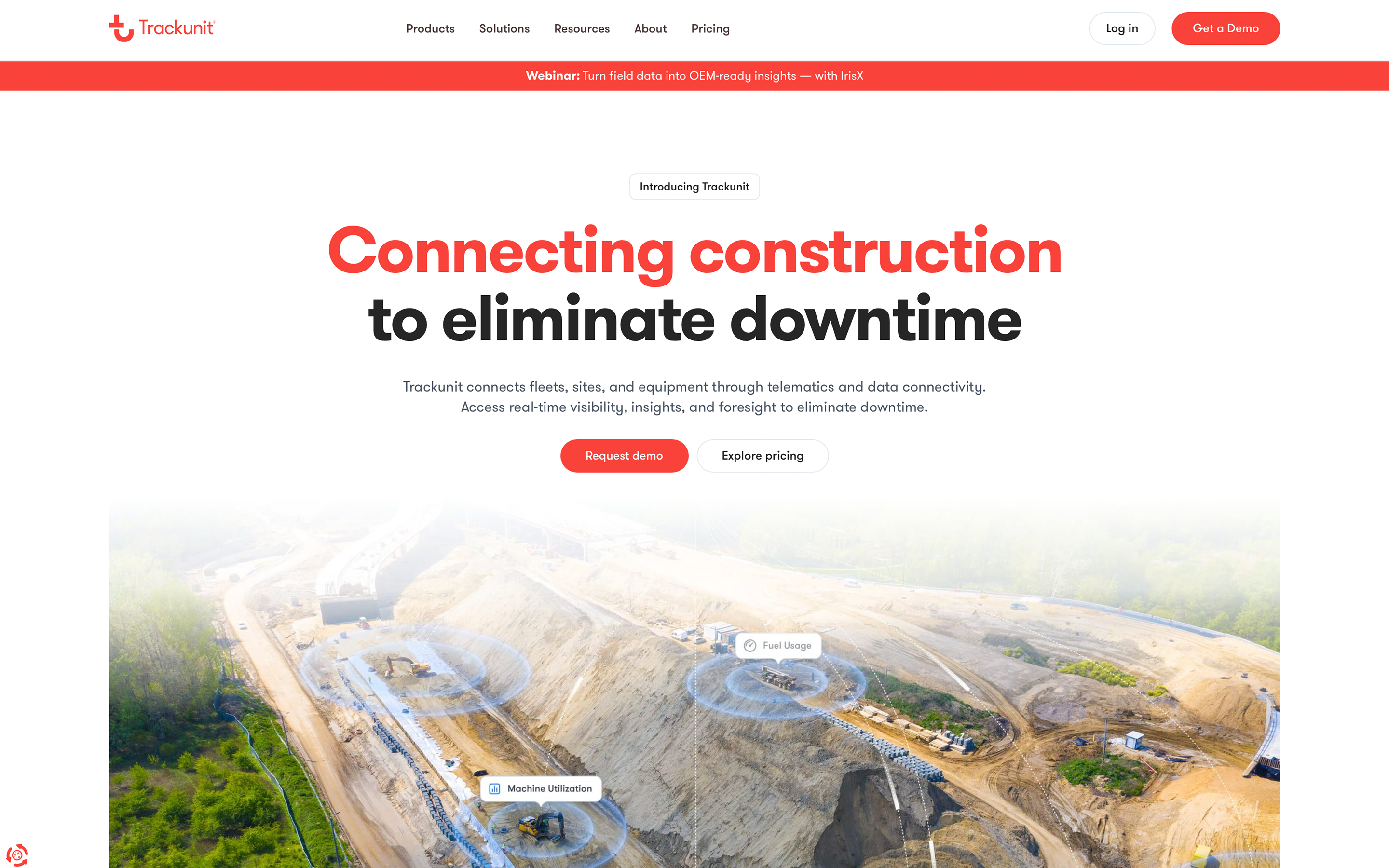
Trackunit offers equipment monitoring solutions that serve the construction and rental industries. The platform connects to construction machinery to record operational data and location information, helping companies monitor usage and manage preventive maintenance schedules based on actual equipment conditions.
While functional for tracking and monitoring, Trackunit’s system is particularly oriented toward rental fleet management rather than the comprehensive mixed-fleet approach that construction contractors with diverse equipment types might require.

Advantages
- Good connectivity with major heavy equipment brands
- Suitable for rental fleet management scenarios
- Decent battery life on tracking devices

Shortcomings
- Limited capabilities for mixed asset fleet management
- Reporting tools less tailored for construction-specific needs
- Interface occasionally presents navigation challenges
- Less emphasis on job costing, billing rates, or construction financial workflows
Key Equipment Utilization Features
| Engine Run Time Monitoring | ✅ Yes |
| Real-Time Asset Tracking | ✅ Yes |
| Power Take Off Monitoring | ❌ No |
| Automated Maintenance Triggers | ✅ Yes |
| Fleet Management Dashboard | ✅ Yes |
| Equipment Utilization Reports | ✅ Yes |
| Configurable Utilization Rates | ❌ No |
| Asset-Level P&L | ❌ No |
| Internal Billing / Job Costing Automation | ❌ No |
| ERP Integration for Equipment Costs | ⚠️ Limited |
| Third-Party OEM | ✅ Yes |
| Third-Party Product Operations Integrations (Procore, Riskcast, etc.) | ⚠️ Limited |
| Mobile App | ✅ Yes |
3. Motive
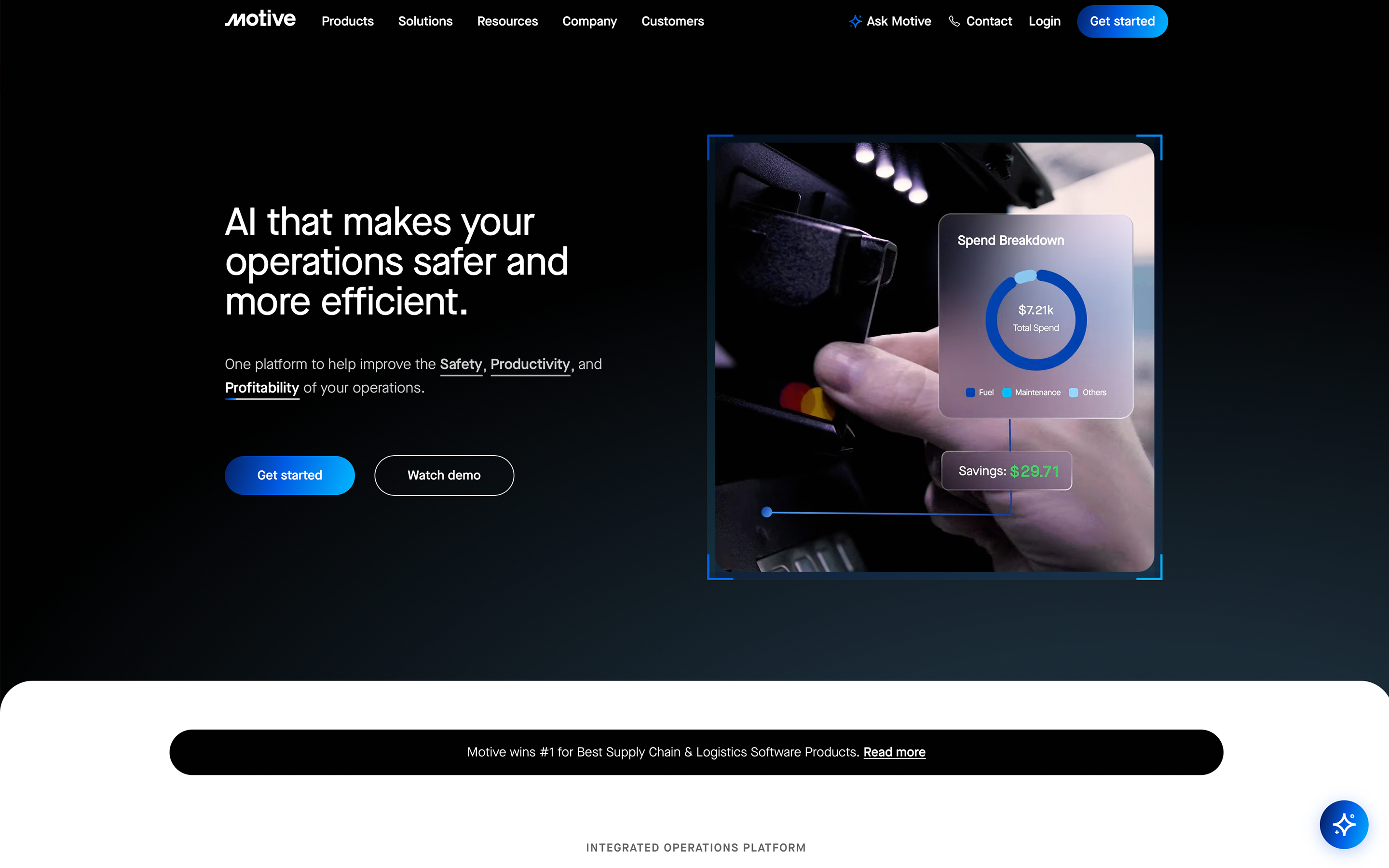
Motive has an integrated fleet and equipment management platform that combines GPS tracking, telematics, and AI-powered insights. It’s designed to give contractors visibility into equipment location, usage, and health across their entire fleet.
This equipment monitoring solution offers location data for asset tracking and engine hour visibility to help with planning and accurate billing. It also identifies both productive and non-productive idling for improved efficiency.
Advantages
- Combines fleet management, equipment monitoring, and spend management
- Real-time visibility into asset location and utilization
- Telematics integration that offers engine hour insights and fault code alerts
Shortcomings
- Higher price point compared to standalone tracking solutions
- Learning curve when implementing the full platform
- Primary focus on vehicles and powered equipment may limit functionality for smaller tools
- Reports of rep turnover, delays in replacements, and resolution challenges
- Utilization insights are generally high-level, with limited support for configurable billing or internal rates
- Job costing integrations often require additional systems
Key Equipment Utilization Features
| Engine Run Time Monitoring | ✅ Yes |
| Real-Time Asset Tracking | ✅ Yes |
| Power Take Off Monitoring | ⚠️ Limited |
| Automated Maintenance Triggers | ✅ Yes |
| Fleet Management Dashboard | ✅ Yes |
| Equipment Utilization Reports | ✅ Yes |
| Configurable Utilization Rates | ❌ No |
| Asset-Level P&L | ❌ No |
| Internal Billing / Job Costing Automation | ⚠️ Limited |
| ERP Integration for Equipment Costs | ❌ No |
| Third-Party OEM | ⚠️ Limited |
| Third-Party Product Operations Integrations (Procore, Riskcast, etc.) | ❌ No |
| Mobile App | ✅ Yes |
4. Fleetio
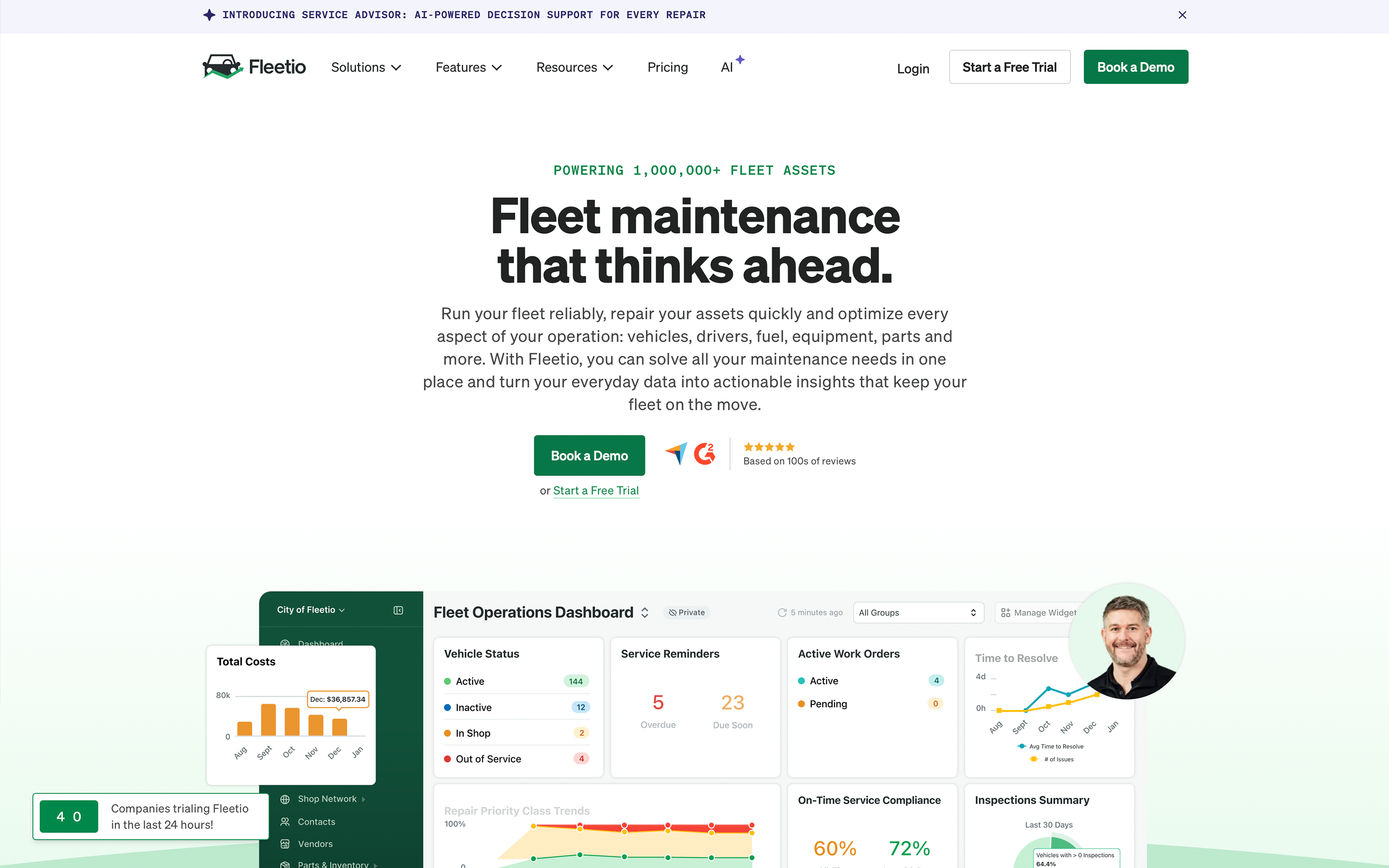
Fleetio delivers a vehicle-centric management system designed for fleet operations. The platform includes features for proactive maintenance scheduling, fuel tracking, and driver management along with tools for monitoring vehicle health and performance.
While Fleetio has solid monitoring capabilities for traditional vehicle fleets, companies with specialized construction assets beyond vehicular equipment may need additional solutions to manage their complete asset inventory.
Advantages
- Reliable vehicle maintenance scheduling capabilities
- Decent fuel tracking functionality
- User-friendly inspection documentation
Shortcomings
- Limited functionality for non-vehicular construction equipment
- Integration options lack construction industry specificity
- Mobile experience could be more robust for field teams
- Job costing, billing rates, and internal equipment charges are typically handled outside the platform
Key Equipment Utilization Features
| Engine Run Time Monitoring | ⚠️ Limited |
| Real-Time Asset Tracking | ⚠️ Limited |
| Power Take Off Monitoring | ❌ No |
| Automated Maintenance Triggers | ✅ Yes |
| Fleet Management Dashboard | ✅ Yes |
| Equipment Utilization Reports | ✅ Yes |
| Configurable Utilization Rates | ❌ No |
| Asset-Level P&L | ❌ No |
| Internal Billing / Job Costing Automation | ❌ No |
| ERP Integration for Equipment Costs | ❌ No |
| Third-Party OEM | ⚠️ Limited |
| Third-Party Product Operations Integrations (Procore, Riskcast, etc.) | ❌ No |
| Mobile App | ✅ Yes |
5. Samsara
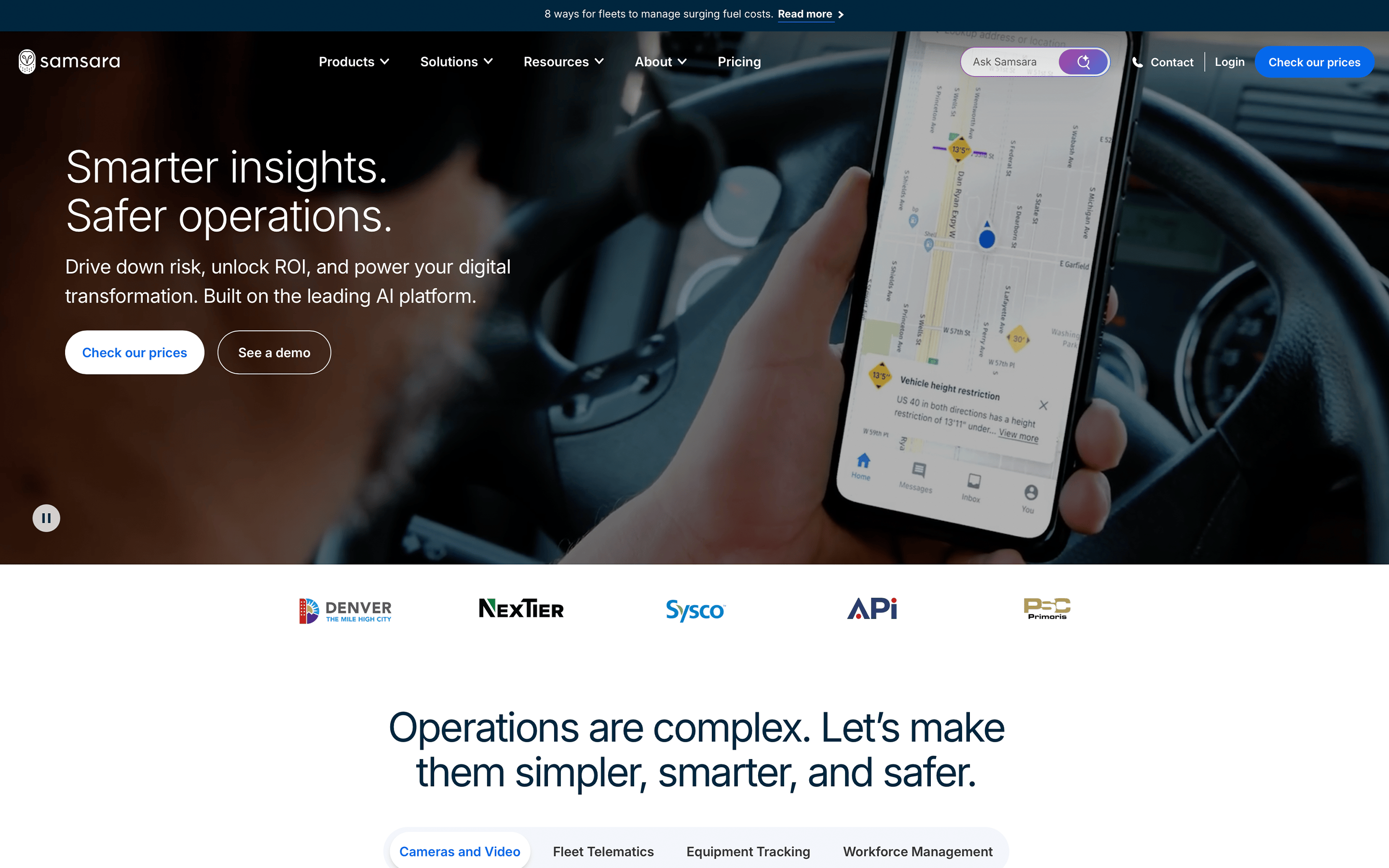
Samsara is an IoT platform that serves the transportation, manufacturing, and construction industries. The system combines hardware sensors and cloud-based software to provide visibility into operations, with features for GPS tracking, equipment monitoring, and safety management.
The platform offers broad functionality across various business types, providing general asset tracking and fleet management tools rather than focusing exclusively on the unique requirements of construction equipment operations.
Advantages
- Reliable GPS tracking functionality
- Specialized telematics hardware
- Advanced AI-driven safety and compliance tools
Shortcomings
- Less construction-specific than dedicated platforms
- Heavy equipment options not as comprehensive
- Subscription model can become costly at scale
- Reports of unresponsive support and unresolved technical issues
- Limited native support for construction-specific utilization definitions (e.g., billable vs. non-billable hours, internal charge rates)
- Job costing and equipment billing typically rely on external systems or integrations, rather than built-in rate logic
Key Equipment Utilization Features
| Engine Run Time Monitoring | ✅ Yes |
| Real-Time Asset Tracking | ✅ Yes |
| Power Take Off Monitoring | ✅ Yes |
| Automated Maintenance Triggers | ✅ Yes |
| Fleet Management Dashboard | ✅ Yes |
| Equipment Utilization Reports | ✅ Yes |
| Configurable Utilization Rates | ❌ No |
| Asset-Level P&L | ❌ No |
| Internal Billing / Job Costing Automation | ❌ No |
| ERP Integration for Equipment Costs | ⚠️ Limited |
| Third-Party OEM | ⚠️ Limited |
| Third-Party Product Operations Integrations (Procore, Riskcast, etc.) | ✅ Yes |
| Mobile App | ✅ Yes |
6. HCSS
HCSS Equipment360 is a construction equipment management platform that provides tools for tracking maintenance, costs, and utilization. It integrates with other HCSS products for estimating, time tracking, and job management.
The system delivers solid equipment management functionality, especially for heavy equipment. However, it works best for companies already using or planning to adopt other components within the HCSS ecosystem.
Advantages
- Designed specifically for construction environments
- Strong alignment between equipment usage, maintenance, and project data
- Cost tracking capabilities
- Mixed-fleet visibility when integrated with partner telematics providers
Shortcomings
- Less flexible for mixed fleets beyond heavy equipment
- Integrations primarily limited to HCSS ecosystem
- Interface could benefit from modernization
- Pricing can get expensive as you add users
- Less flexibility around custom utilization rate modeling for billing and internal cost recovery
Key Equipment Utilization Features
| Engine Run Time Monitoring | ✅ Yes |
| Real-Time Asset Tracking | ✅ Yes |
| Power Take Off Monitoring | ⚠️ Limited |
| Automated Maintenance Triggers | ✅ Yes |
| Fleet Management Dashboard | ✅ Yes |
| Equipment Utilization Reports | ✅ Yes |
| Configurable Utilization Rates | ⚠️ Limited |
| Asset-Level P&L | ⚠️ Limited |
| Internal Billing / Job Costing Automation | ⚠️ Limited |
| ERP Integration for Equipment Costs | ✅ Yes |
| Third-Party OEM | ✅ Yes |
| Third-Party Product Operations Integrations (Procore, Riskcast, etc.) | ⚠️ Limited |
| Mobile App | ✅ Yes |
How Top Construction Companies Track Their Equipment’s True Utilization and Value
The most successful construction companies in 2026 don’t measure equipment value by ownership alone — they measure it by how effectively each asset contributes to project profitability. That requires more than knowing where a machine is or how many hours it ran. It requires knowing what those hours actually cost, which job they should be charged to, and whether the asset is earning its keep.
That’s the gap most utilization platforms still can’t close. They tell you what your equipment is doing. They don’t tell you what it’s costing — or what it’s worth.
Tenna does both.
Built specifically for contractors managing mixed fleets, Tenna connects real machine activity to your financial workflows so equipment costs flow to the right jobs automatically. Live telematics data drives job costing. Geofencing assigns assets to jobs without manual entry. Your rate logic — by asset class, utilization status, job type — applies consistently every time. And when a work order closes, those costs roll up into the asset’s P&L alongside everything else.
The result: a complete, real-time picture of what every machine is costing and earning, per job and per period — without a month-end scramble to produce it.
For contractors who are ready to move from utilization tracking to equipment financial intelligence, Tenna is the only platform built for both.
