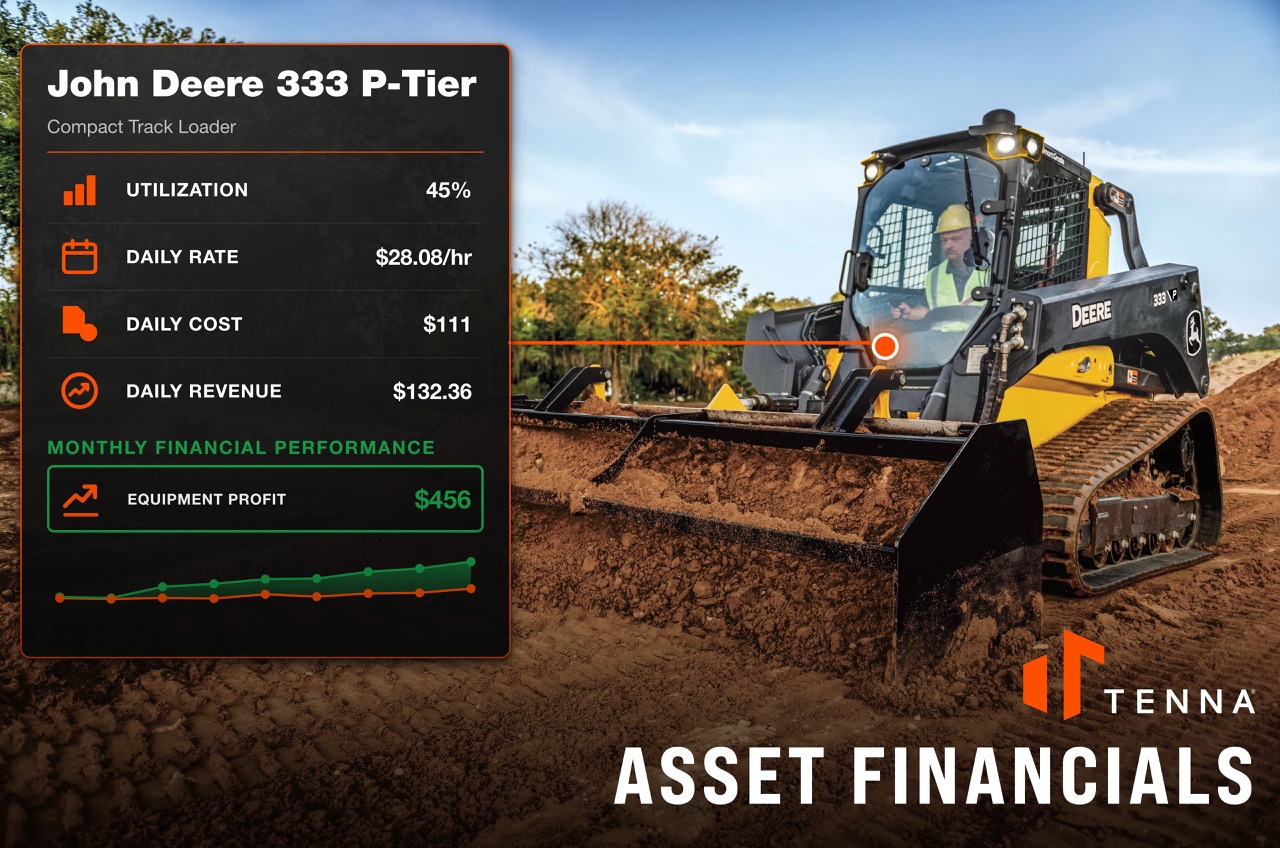
Asset Financials closes the longstanding gap between what equipment and assets do in the field and how they get costed and billed on the books, automatically computing equipment job costing, internal billing and real-time asset-level profit and loss from live operational data.
New Hope, PA (July 7, 2026) – TENNA, the construction equipment management software powering mixed fleet operations, today announced the launch of Asset Financials, the construction industry’s first telematics-powered equipment economics engine, enabling automated equipment job costing, internal billing and real-time asset-level P&L. This bold expansion unites operational and financial data, empowering self-performing contractors owning and operating heavy equipment with real-time profit and loss visibility per asset for the first time.
Asset Financials answers a question contractors have been asking for decades: “how much did that piece of equipment actually cost or earn on that job?” Until now, no software has connected the operational truth of what equipment does in the field to the financial systems responsible for recording it. The result has been an industry-wide reliance on manual processes, estimated hours, and rate assumptions that rarely reflect reality.
For self-performing contractors, owned equipment represents one of the largest capital investments on the balance sheet. Yet it remains one of the most difficult cost categories to account for accurately. The challenge is structural: equipment cost data is fragmented across systems that were never designed to talk to each other. Depreciation and financing costs sit in the ERP. Maintenance history lives in the CMMS. Fuel consumption is tracked in fleet card data. Utilization comes from telematics, if it’s tracked at all. The connection between all of this and a specific job, cost code, and billing period has traditionally required a person to assemble it manually, after the fact.
The consequences are familiar to anyone who manages construction finances:
- Internal rate tables set years ago and revisited annually at best, even as actual costs change
- Shop billing based on operator timecards that field teams routinely dispute
- Equipment costs allocated in lump sums to general ledger accounts rather than tracked per asset
- Month-end reconciliation that delays financial reporting and produces numbers that can’t be defended
- No reliable answer to which jobs or which assets are actually profitable
ERPs were built to record financial transactions, not to capture jobsite activity. Telematics platforms provide operational visibility but stop short of feeding that data into the financials. Asset Financials is built to close this gap.
The Equipment Triangle: one asset, three sets of books
Behind every disputed equipment charge is a structural reality that predates any software. As equipment economist Mike Vorster puts it:
“Equipment is a shared resource whose cost must be visible to the people using it, managed by the people maintaining it, and accurately captured by the people closing the books.” – Mike Vorster, Construction Equipment Economics, V2
That is three functions with three different stakes in the same machine. The operations team needs equipment cost visible against job margin. The equipment division sets and owns the internal charge and keeps the iron running. Finance is responsible for capturing all of it accurately enough to close the books and defend the numbers. Today those three often meet only at month-end, in spreadsheets and reconciliation calls, and by then the damage is done. With nothing left to fix, the meeting is less of a working session and more of an argument over who’s to blame in disputes no one has the data to settle.
Asset Financials gives all three points on the triangle the same source of truth. The charge the equipment division sets, the margin operations sees, and the cost finance books all trace back to the same machine activity, in real time, so questions surface the day after, not the month after, while the job is still running and the answer can still change the outcome. The fleet runs on one set of numbers instead of three, and the review can move from a month-end reckoning to a next-day check, while it’s still a question and not yet a grievance.
Asset Financials: the missing link
This first-to-market product uses the operational data already flowing through Tenna and applies configurable rate rules to automatically compute job-level cost and revenue attribution per asset, in real time. Asset Financials turns the asset into a self-reporting resource that tells you where it was and how long it worked.
“This is the construction market’s missing link,” said Austin Conti, Co-Founder and CEO of Tenna. “For the first time, contractors can leverage real-world machine data to drive equipment job costing and internal billing decisions with accuracy, speed, and confidence.”
Equipment job costing and internal billing logic (or “charging”, depending on contractor terminology) varies significantly across contractors by asset class, project type, contract structure, and internal accounting practice. Asset Financials does not impose a standardized rate model, and it does not build rates for you. Instead, it provides a configurable rule engine that automates whatever rate logic the contractor already uses.
Rates can be configured at the account level as organization-wide templates, establishing baseline logic for how each asset class is charged across all jobs. They can also be set at the job level to accommodate specific contract requirements, project-specific conditions, etc., overriding the account default where needed.
This combination of account-wide templates and job-specific rates is a meaningful differentiator: it gives finance teams consistency and control at the organizational level while preserving the flexibility field operations and project managers need.
“If you can explain your rate logic today, we can automate it,” said William Hipp, Product Analyst at Tenna. “Every contractor thinks their billing structure is uniquely complex, and they’re usually right. We built Asset Financials to support the model already in place, not to replace it with something generic.”
The rate engine supports differentiated logic for working, idle, and standby status; asset class and job-specific overrides; and production-based workflows, automatically applying the right rate to the right machine in the right context, without manual recalculation.
The goal of Asset Financials is to determine, at any point in time, whether each asset in the fleet (from equipment, to vehicles, to mid-sized assets, tools and more) is earning its keep by job, by period, and in aggregate. It produces:
- Real-time asset P&L: An asset-level profit and loss view per machine, built from the cost and revenue that flow from actual machine activity, updated continuously as operational data comes in
- Automated job costing: Equipment costs allocated to specific jobs and cost codes based on actual activity from the machine, not estimates or operator reports
- Internal billing records: Defensible internal charge documentation grounded in telematics data, available to resolve disputes between the shop, project teams, and finance without phone calls or manual reconciliation
- Fleet-level profitability benchmarks: Over time, aggregated asset P&L data across the fleet and internal benchmarks by equipment and asset class, providing the financial basis for purchase, rental, redeployment, and replacement decisions
- ERP-ready output: Financial data formatted for existing accounting systems with the operational context needed to stay accurate
“Contractors now have a system that uses what their machines and other owned assets actually do to drive what gets charged and costed to a job, and how,” said Conti. “The data has always been there. Asset Financials puts it to work.”
Asset Financials is not an ERP and is not designed to replace one. It becomes the operational layer that feeds ERPs the equipment data they need to produce accurate job cost reports, without requiring contractors to change how they use their existing accounting systems or overhaul established financial workflows.
“We’re not replacing ERPs,” said Jose Cueva, Tenna Co-Founder and Chief Product Officer. “We’re better informing them. Asset Financials is the ERP’s new best friend, delivering the operational truth about your equipment and other supporting assets so your financials are always accurate, real-time, and defensible.”
Asset Financials is available now. Stop estimating what your equipment costs and start truly knowing. To learn more about this market-first product or schedule a demo, visit tenna.com/asset-financials.
About Tenna
Tenna is the construction technology platform powering equipment fleet operations. Beyond tracking, Tenna connects every aspect of fleet management, giving contractors a full-picture view of their equipment operations and a greater understanding of equipment trends, so they can increase productivity and reduce costs. With more than 100 years of construction experience, Tenna helps contractors maximize their mixed fleet with industry-focused solutions that connect field, shop and office to optimize all aspects of equipment management. For more information, visit tenna.com.
Join the discussion on the Tenna Blog, watch our Customer Stories and connect with Tenna on LinkedIn, Facebook, Instagram and YouTube.