After a week at CONEXPO talking with hundreds of contractors, fleet leaders, and executives across the industry, one thing became incredibly clear: We are at an inflection point in construction technology. Not because there’s a lack of innovation, but because there’s too much of the wrong kind.
I distilled dozens (honestly, hundreds) of conversations into three concepts that are hard to argue with — and even harder to ignore:
- Simplifying matters more than ever.
- Focus matters more than we’d like to admit.
- Change is no longer a destination
If you agree with those three, the path forward becomes pretty obvious.
The Problem: Why the Modern Construction Tech Stack Isn’t Delivering Results
For years, the industry has been told a simple story: “Buy more technology. Integrate it all. You’ll be fine.” So that’s what companies did.
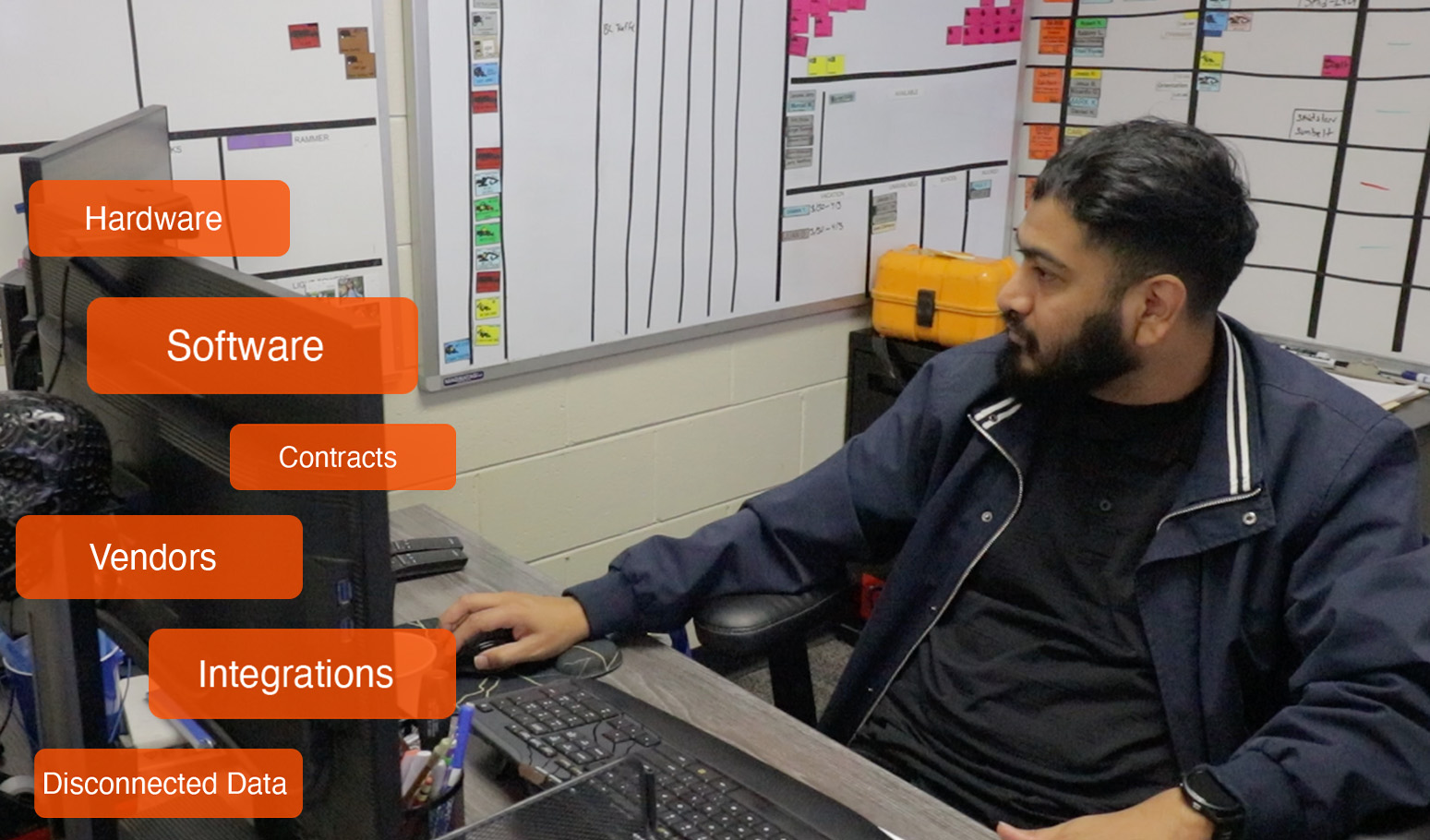
Today, it’s not uncommon to see contractors juggling:
- 30, 40, even 50+ different software and hardware solutions
- Dozens of contracts and vendors
- Endless integration projects
- Disconnected data across departments
And then we tell them: “Don’t worry—We’ll just snap it all together.”
Here’s the reality: The data says that approach isn’t working. We’ve now seen self-reported data from over 1,200 construction companies, and the pattern is consistent:
- The more fragmented the construction tech stack, the harder it is to execute.
- Integration complexity slows down operations.
- Data becomes less trustworthy — not more.
- Adoption in the field drops.
This isn’t an opinion. It’s what contractors are telling us.
The highest-performing companies are doing something different. They’re moving toward a centralized platform model — a hub-and-spoke system with a single source of record and tightly integrated workflows.
Why Simplifying Your Construction Tech Stack Matters More Than Ever
We need to stop selling more tech on top of more tech. Because what contractors actually need is:
- Repeatable processes
- Faster onboarding
- Higher adoption in the field
- Less friction between teams
|
✅ When your systems are simple:
|
❌ When they’re not:
|
More tech is not the answer. Better, purpose-built tech is.
Why Focused, Purpose-Built Construction Technology Improves Your Business
Let’s make this simple: If you’re building a highway, you hire a heavy civil contractor — not a mechanical firm. Yet in technology, we ignore this principle all the time. Construction companies regularly buy:
- Tools not built for construction
- Platforms designed for other industries
- Solutions that require heavy customization just to function
The result is worse outcomes, consistently. The data shows that when you use tools not purpose-built for your work, performance suffers. It’s the simplest analogy I use: “Got a nail? Get a hammer.”
Purpose-built construction software understands your workflows, speaks your language, and aligns with how your teams actually operate. Generic tools often require you to adapt your business to the software — instead of the software supporting your business.
Why Your Construction Tech Stack Must Continuously Evolve
This one might be the biggest shift of all. We used to think: “Once we implement this system, we’re set.” That world is gone.
Today, AI is evolving rapidly, safety expectations are increasing, workforce dynamics are changing, and data expectations are rising. Change isn’t something we complete anymore. It’s something we continuously manage. The best companies are embracing this. They’re not just buying technology. They’re building long-term partnerships with providers who evolve alongside them.
Here’s where many still get it wrong:
- 👎 They build a perfect RFP.
- 👎 They select a vendor based on today’s requirements.
- 👎 Then expect that solution to carry them indefinitely.
But the best-performing organizations understand that the RFP is where the work begins, not where it ends. They go deeper:
- “What does a day in the life actually look like?”
- “How will this evolve over the next 3–5 years?”
- “How do people, process, and technology move forward together?”
Why Construction Technology Consolidation Is Winning: The Platform Advantage
When you step back, the move from a complex construction tech stack toward a more comprehensive single platform isn’t about convenience. It’s about performance.
Data You Can Actually Trust
Multiple systems lead to conflicting data. A unified platform offers one version of the truth.
Higher Adoption in the Field
If it’s simple and intuitive, people use it. If not, they don’t. It’s that simple.
Faster Onboarding
New hires don’t want to learn 10 systems. They want something that just works.
Lower Total Cost
Even if individual tools seem cheaper:
- 💵 Integration costs add up.
- 💵 Training costs multiply.
- 💵 Vendor management becomes a full-time job.
Better Decision Making
When your data lives in one place:
- Reporting improves.
- Insights become actionable.
- Leaders move faster and with confidence.
The Workforce Factor: This Is Bigger Than Technology
Here’s a stat that should get everyone’s attention: 76% of employers are investing in better workplace technology to attract and retain Gen Z workers.
Think about that. We’re in a labor-constrained environment, and technology experience is now a deciding factor in retention.
|
✅ Simple, intuitive platforms:
|
❌ Complex, fragmented systems?
|
The iPhone Analogy (Because It’s Real)
There are:
- 📷 Cameras with better lenses
- 🧾 Calculators with more features
- 🔦 Flashlights that are brighter
But most people just use their iPhone. Not because it’s the best at every single function, but because it’s good at everything, simple to use, and fully integrated into daily life.
That’s where construction technology is heading. You can absolutely buy best-in-class point solutions or build your own systems and stitch everything together with APIs. But that should be the exception — not the strategy.
A Quick Word on APIs and Reality
I hear this all the time: “We’ll just connect everything with APIs.” In theory? Great. In reality?
- APIs are often incomplete.
- Data mapping is more complex than expected.
- Integration requires ongoing maintenance.
- Most companies don’t go deep enough into how data actually flows.
APIs are part of the solution, but they are not the strategy.

AI, Cameras, and the Human Element
Besides maintenance woes, two of the hottest topics at CONEXPO involved AI and cameras. And yet, many field teams aren’t excited about cameras and are skeptical (or fearful) of AI. Why? Because of how it’s introduced.
One contractor said it best: “My kid wouldn’t like me putting a tracker on him, but he loves it when I give him a new iPhone.”
That’s the lesson. If technology feels like surveillance, adoption drops. If technology feels like a tool that makes life easier, adoption skyrockets. When companies layer on more tools, more alerts, and more systems, compliance decreases and engagement drops. When they deliver a simple, unified platform that helps people do their jobs better, utilization increases, safety improves, and outcomes get better.
The Bottom Line
After all the conversations at CONEXPO, here’s what I’m confident in:
- 🏆 Simple wins.
- 🏆 Focused wins.
- 🏆 Platforms win.
- 🏆 Partnerships win.
And most importantly, the companies that embrace this shift will outperform those that continue stacking point solutions and hoping integrations solve the problem.
Construction has always been great at building things. Now we’re learning how to build better systems around how we operate.
There will always be cases where specialized tools make sense and custom solutions are required.
The future belongs to contractors who consolidate, simplify, and partner for the long term. We’re not chasing perfection. We’re building toward continuous improvement together.